|
|
Books by and about 2020 presidential candidates |
|
Crippled America,
by Donald J. Trump (2015) |
United,
by Cory Booker (2016) |
The Truths We Hold,
by Kamala Harris (2019) |
Smart on Crime,
by Kamala Harris (2010) |
Guide to Political Revolution,
by Bernie Sanders (2017) |
Where We Go From Here,
by Bernie Sanders (2018) |
Promise Me, Dad ,
by Joe Biden (2017) |
Conscience of a Conservative,
by Jeff Flake (2017) |
Two Paths,
by Gov. John Kasich (2017) |
Every Other Monday,
by Rep. John Kasich (2010) |
Courage is Contagious,
by John Kasich (1998) |
Shortest Way Home,
by Pete Buttigieg (2019) |
The Book of Joe ,
by Jeff Wilser (2019; biography of Joe Biden) |
Becoming,
by Michelle Obama (2018) |
Our Revolution,
by Bernie Sanders (2016) |
This Fight Is Our Fight,
by Elizabeth Warren (2017) |
Higher Loyalty,
by James Comey (2018) |
The Making of Donald Trump,
by David Cay Johnston (2017) |
|
Books by and about the 2016 presidential election |
|
What Happened ,
by Hillary Clinton (2017) |
Higher Loyalty ,
by James Comey (2018) |
Trump vs. Hillary On The Issues ,
by Jesse Gordon (2016) |
Hard Choices,
by Hillary Clinton (2014) |
Becoming ,
by Michelle Obama (2018) |
Outsider in the White House,
by Bernie Sanders (2015) |
|
|
Book Reviews |
(from Amazon.com) |
(click a book cover for a review or other books by or about the presidency from Amazon.com)
|
Slouching Towards Gomorrah
Modern Liberalism and American Decline
by Robert Bork
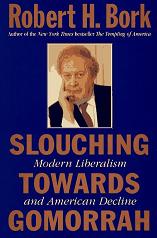
(Click for Amazon book review)
BOOK REVIEW by OnTheIssues.org:
Robert's book conservative classic is included in our 2009 book reviews because of Bork's connection with Vice President Joe Biden. Bork was nominated as a Supreme Court Justice by Pres. Reagan in 1987, when Biden was chair of the Senate Judiciary Committee, which oversaw Supreme Court nomination hearings. Bork's hearing is generally considered the hallmark of contentiously politicized Supreme Court nominations. It resulted in the coining of a new political term, "to bork," which means to oppose a political appointment on any grounds possible. Bork's qualifications were not at issue in the Supreme Court nomination; rather, Biden's opposition was based on Bork's politics, which are expressed clearly in this book.
Joe Biden's view prevailed, and Bork was rejected in his Supreme Court nomination. As a result of his political disenchantment based on that rejection, Bork resigned his appellate-court judgeship the next year. To some extent, this book is a result of that same disenchantment. While Bork does not explicitly discuss the nomination process, his disenchantment about America politics is the central theme of this book. Bork blamed the liberals for his failed nomination, and in this book he blames the liberals for all of the failings of America.
The title of this book indicates Bork's pessimism about America's future. "Gomorrah" is a Biblical reference: it was a city that was destroyed for its immorality. Bork's title means he thinks that America's level of immorality will destroy us. Bork's list of slouches focuses on universities, the Supreme Court, and media-based culture.
By "slouching," Bork means that America is already sliding down a "slippery slope" towards destruction by immorality. For example, Bork writes, "Despite assurances that abortion decisions did not start us down a slippery and very steep slope, that is clearly where we are, and gathering speed. The movement to make assisting suicide legal was made virtually inevitable by the Supreme Court's creation of a right to abortion" (pp. 185-6). Bork's argument is articulate but far-fetched. When I clip my fingernails, I don't worry much about clipping my fingers, then progressing down the slippery slope past my hand and wrists. Bork then extends the same argument to the inevitability of euthanasia -- that's equivalent to a nail-clipping slippery slope extending well beyond my elbow.
Bork's argument might be politically interesting if it were not so pessimistic. Bork is pessimistic even about Supreme Court appointments (perhaps some sour grapes that his being on the Supreme Court wouldn't have mattered?): "Republican presidents have appointed Justice after Justice with the avowed intention of changing Court's direction. That has not worked." (p. 114). This book is pessimism from the very beginning (p. 2): "This is a book about American decline"; to the very end (p. 334): "The best strategy for those of us who detest modern liberalism and all its works may be simply to seek sanctuary, to attempt to create small islands of decency and civility in the midst of a subpagan culture. Gated communities and the home-schooling movement are the beginning of such responses."
Most pessimistic books end with a prescription of action to give readers hope. This book's final paragraph includes this description of America: "As we approach its desolate and sordid precincts, the pessimism of the intellect tells us that Gomorrah is our probable destination." So no hope at the end; the prescription lay in exploring where the slouch Towards Gomorrah began.
Bork pinpoints the start of America's slouching morality to 1962, and specifically to a document called "The Port Huron Statement," produced by the SDS (Students for a Democratic Society), an influential anti-war organization which was then just getting started. Bork cites one SDS advocate's description: "four-square against anti-Communism; eight-square against American culture; and 120-square against an interpretation of the Cold War that saw it as an American plot." I have long admired the SDS and hence I can confirm that that's indeed the SDS attitude -- but in the intervening 47 years, they have been proven right on all three points: anti-Communism was unmasked as Congressional bullying; even Bork admits that pre-1962 American culture was worse for blacks and women than today; and the CIA has long admitted that their estimates of Cold War-era Soviet strength were trumped up to facilitate the Vietnam War and a nuclear buildup. Bork's interpretation of the SDS statement, however, is that "in short, they rejected America" (p. 26). Yes, indeed, the SDS rejected a bullying, anti-black, anti-women, militaristically-misleading America -- they rejected those American POLICIES, without rejecting America. Bork disagrees, and implicitly supports those policies.
Bork's support of 1950s-based American policies and values is the reason he got "borked." Bork lays out his views on policies and values very clearly in this book. To put those views into OnTheIssues terms, they focus on the first four questions in our VoteMatch quiz, to which Bork devotes an entire chapter to each one:
- Abortion: Bork's chapter 10, "Killing for Convenience: Abortion, Assisted Suicide, and Euthanasia"
- Minority and women's rights: Bork's chapter 12, "The Dilemmas of Race", and chapter 11, "The Politics of Sex: Radical Feminist's Assault on American Culture"
- Gay rights: Bork's chapter 6, "The Supreme Court as an Agent of Modern Liberalism"
- School prayer: Bork's chapter 14, "The Trouble in Religion"
|
The rest of Bork's Table of Contents is as illustrative of his beliefs as the examples above -- another chapter title, "The Case for Censorship," chapter 8, focuses a dozen pages in which Bork actually does make the case that censorship is a good thing. On the book's final page, Bork reiterates his conclusion that America's only hope is "perhaps in administering censorship of the vilest aspects of our popular culture" (p. 342). As a member of the free press and hence against any censorship, and one who believes that Supreme Court justices should respect the First Amendment, I concur with Joe Biden that it's a good thing Bork got borked.
-- Jesse Gordon, editor-in-chief, OnTheIssues.org, Nov. 2009
| OnTheIssues.org excerpts: (click on issues for details)
|
Abortion
Bill Clinton: Vetoed partial birth abortion ban for having no exceptions.
Ronald Reagan: Appointed Justices with intent making Court less political.
|
Civil Rights
Joe Biden: 1987 Biden Report: Reject Bork; he'd roll back civil rights.
Ted Kennedy: 1987: "Robert Bork's America" means censorship & segregation.
Anthony Kennedy: Recognize GLBT as a constitutionally-protected class.
Antonin Scalia: Don't recognize GLBT as a constitutionally-protected class.
Antonin Scalia: Opposing homosexuality not as reprehensible as racial bias.
Clarence Thomas: Don't recognize GLBT as a constitutionally-protected class.
David Souter: Recognize GLBT as a constitutionally-protected class.
John Paul Stevens: Recognize GLBT as a constitutionally-protected class.
Ruth Bader Ginsburg: Recognize GLBT as a constitutionally-protected class.
Sandra Day O`Connor: Recognize GLBT as a constitutionally-protected class.
Stephen Breyer: Recognize GLBT as a constitutionally-protected class.
William Rehnquist: Don't recognize GLBT as a constitutionally-protected class.
|
Education
Mario Cuomo: Public schools inculcate a disbelief in God.
Rev. Jesse Jackson: Protested courses on Western Culture as racist & sexist.
|
Government Reform
Joe Biden: 1987: Rejected Bork on grounds of too-strong originalism.
George Bush Sr.: Appointed Justices with intent of changing Court's direction.
|
Homeland Security
Anthony Kennedy: All-male military schools like VMI must admit women.
Antonin Scalia: All-male military schools like VMI should stay all-male.
Clarence Thomas: Recused himself from decision on all-male status of VMI.
David Souter: All-male military schools like VMI must admit women.
John Paul Stevens: All-male military schools like VMI must admit women.
Richard Nixon: OpEd: Invasion of Cambodia led to 1970 Kent State killings.
Ruth Bader Ginsburg: All-male military schools like VMI must admit women.
Sandra Day O`Connor: All-male military schools like VMI must admit women.
Stephen Breyer: All-male military schools like VMI must admit women.
William Rehnquist: All-male military schools like VMI must admit women.
|
Principles & Values
Bill Clinton: OpEd: 1994 loss resulted in adoption of GOP rhetoric.
Bill Clinton: OpEd: 1992 election represented moral & cultural sea change?
Clarence Thomas: OpEd: Nomination hearing showed end of Western civilization.
Pat Moynihan: Defining deviancy down: once-reprehensible conduct now ok.
Ronald Reagan: 1980 Reagan Revolution included defeat of liberal Senators.
Rush Limbaugh: OpEd: Demonstrates the absurdity of official media dogma.
Hillary Clinton: OpEd: "Politics of meaning" was 1960s student radicalism.
Hillary Clinton: OpEd: "Crisis of meaning" is unified-field theory of life.
|
Tax Reform
Bill Clinton: Proposed raising taxes on rich even if no revenue increase.
|
Technology
Bob Dole: Denounces worst of popular culture, but no censorship.
|
War & Peace
Richard Nixon: OpEd: Sought only to get out of Vietnam on honorable terms.
|
The above quotations are from Slouching Towards Gomorrah
Modern Liberalism and American Decline
by Robert Bork.
2010 Election Analysis:
- Against All Odds, by Scott Brown
- The Obamians, by James Mann
- Power to the People, by Gov. Tommy Thompson
- 2010: Take Back America, by Dick Morris
- 100 Innovative Ideas for Florida's Future, by Marco Rubio
- Courage and Consequence, by Karl Rove
- American Conspiracies, by Gov. Jesse Ventura
- Game Change, by John Heilemann and Mark Halperin
- The FairTax Book, by Neal Boortz and Rep. John Linder
- The Test of our Times, by Gov. Tom Ridge
- Saving Freedom, by Sen. Jim DeMint
- Giving, by Pres. Bill Clinton
- Going Rogue, by Gov. Sarah Palin
- Slouching Towards Gomorrah, by Robert Bork
- Abortion and the Conscience of a Nation, by Pres. Ronald Reagan
- Third World America, by Arianna Huffington
- Hopes and Prospects, by Noam Chomsky
- Rise of the Vulcans: The History of Bush's War Cabinet, by James Mann (March 2004)
- Earlier election analyses
|
|