|
|
Books by and about 2020 presidential candidates |
|
Crippled America,
by Donald J. Trump (2015) |
United,
by Cory Booker (2016) |
The Truths We Hold,
by Kamala Harris (2019) |
Smart on Crime,
by Kamala Harris (2010) |
Guide to Political Revolution,
by Bernie Sanders (2017) |
Where We Go From Here,
by Bernie Sanders (2018) |
Promise Me, Dad ,
by Joe Biden (2017) |
Conscience of a Conservative,
by Jeff Flake (2017) |
Two Paths,
by Gov. John Kasich (2017) |
Every Other Monday,
by Rep. John Kasich (2010) |
Courage is Contagious,
by John Kasich (1998) |
Shortest Way Home,
by Pete Buttigieg (2019) |
The Book of Joe ,
by Jeff Wilser (2019; biography of Joe Biden) |
Becoming,
by Michelle Obama (2018) |
Our Revolution,
by Bernie Sanders (2016) |
This Fight Is Our Fight,
by Elizabeth Warren (2017) |
Higher Loyalty,
by James Comey (2018) |
The Making of Donald Trump,
by David Cay Johnston (2017) |
|
Books by and about the 2016 presidential election |
|
What Happened ,
by Hillary Clinton (2017) |
Higher Loyalty ,
by James Comey (2018) |
Trump vs. Hillary On The Issues ,
by Jesse Gordon (2016) |
Hard Choices,
by Hillary Clinton (2014) |
Becoming ,
by Michelle Obama (2018) |
Outsider in the White House,
by Bernie Sanders (2015) |
|
|
Book Reviews |
(from Amazon.com) |
(click a book cover for a review or other books by or about the presidency from Amazon.com)
|
Seize Freedom!
American Truths and Renewal in a Chaotic Age,
by Rep. Thad McCotter
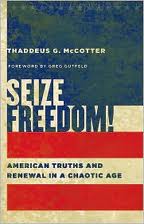
(Click for Amazon book review)
Click on a participant to pop-up their full list of quotations
from Seize Freedom, by Rep. Thad McCotter (number of quotes indicated):
- John Paul Stevens (1)
- Ronald Reagan (5)
- Thad McCotter (33)
OR click on an issue category below for a subset. |
OnTheIssues.org BOOK REVIEW:
We're not sure why Thad McCotter is running for President. He's a five-term member of the U.S. House of Representatives, but no member of the house has won the presidency since 1880. Unlike McCotter, his two House colleagues running for the presidency in 2012 do have substantive presidential credentials: Rep. Ron Paul (R, TX) invented Republican grassroots Internet politics in 2008; and Rep. Michele Bachmann (R, MN) chairs the House Tea Party caucus. Perhaps McCotter is actually running for Governor, and just wants his name made more well-known nationally.
OnTheIssues.org usually adores non-mainstream candidates, and indeed was founded to give them more equal footing with the mainstream. But McCotter is just too nasty to fulfill the "firebrand" role like Sen. Mike Gravel (D, AK) did in 2008. Sen. Gravel made incomprehensible wordless Internet ads showing him throwing rocks into a lake and then walking away; Rep. McCotter seems to be following this model by writing incomprehensible passages about political philosophers like Wilhelm Röpke (whom he cites three times in this book!). But Sen. Gravel was charmingly iconoclastic, while Rep. McCotter is just plain nasty.
For example, McCotter dismisses the 1960s by admiringly citing his father's take on hippies as "spoiled rotten jackasses" (p. 39). McCotter goes on to further name-calling, describing the New Left as "intellectually adolescent" (p. 39); declaring that the Left seeks "active euthanasia" (p. 41, which presumably means killing superannuated grandmothers); and deriding the Left for being "too European" (p. 39). That last accusation is particularly odd from a writer who routinely cites European philosophers as both positive and negative examples, from the aforementioned Wilhelm Röpke (a German socialist); to Fyodor Dostoevsky (p. 35, the Russian writer); to countless citations of Jean-Jacques Rousseau (the French revolutionary philosopher).
McCotter truly hates Rousseau -- who lived from 1712 to 1778, although McCotter bashes him as if he's part of the American Left's daily thoughts. For example, the Left is accused of "anointing itself Rousseau's Legislator" (p. 40, and oft repeated). I've attended many a Leftist powwow, and no one has even mentioned Rousseau, much less described "Rousseau's Legislator" -- in fact, the only time I ever recall Rousseau's name coming up was at a meeting of the Harvard University Libertarian Caucus, not a Leftist organization at all.
McCotter's citations of philosophers extends well beyond Rousseau. He hits the usual suspects: Edmund Burke (p. 31 & 53); Saul Alinsky (p. 155); and Francis Fukuyama (p. 44). But he also hits the unusual: Alfred Lord Tennyson (p. 56); Antonio Gramsci (p.140); and Franz Schurmann (p. 141). Citing philosophers is nice -- if one is establishing one's intellectual bona fides, or writing an academic treatise. But doing so in a book intended to establish one's basis for the presidency just alienates the reader. Rep. Newt Gingrich does the same with his over-reliance on historical citations in A Nation Like No Other; McCotter should have learned the lesson from Gingrich about how alienating is that method.
McCotter certainly alienated me. I read this book hoping to hear a fresh voice with a fresh perspective to further stir up the GOP primary and establish McCotter as a future conservative thought leader. Instead all I heard was shrill shrieking.
-- Jesse Gordon, editor-in-chief, OnTheIssues.org, July 2011
| OnTheIssues.org excerpts: (click on issues for details)
|
Abortion
Thad McCotter: Roe let government decide which life deserves protection.
|
Budget & Economy
Ronald Reagan: Enduring economy comes from fiscal integrity & sound money.
|
Corporations
Ronald Reagan: Goal is not material gain; but to renew the American dream.
Thad McCotter: Decentralized virtual corporations create rootless capital.
|
Education
Thad McCotter: Reverse federal discrimination against charters & homeschool.
|
Energy & Oil
Thad McCotter: Climate change is pseudo-scientific scare tactic.
|
Environment
John Paul Stevens: Eminent domain ok for promoting economic development.
Thad McCotter: Eminent domain guts private property rights.
|
Families & Children
Ronald Reagan: All great change in America begins at the dinner table.
|
Foreign Policy
Thad McCotter: If America falters, there is no other nation to replace her.
Thad McCotter: Support the liberation of Tibet.
Thad McCotter: Diminish the debased UN; Liberty Alliance instead.
|
Free Trade
Thad McCotter: Replace chimera of "free trade" with fair competition.
|
Government Reform
Thad McCotter: Freedom Paradigm: good government empowers citizens.
|
Health Care
Thad McCotter: Left foisted government-run bureaucrat-dictated medicine.
|
Homeland Security
Thad McCotter: Security through strength; not surrender.
Thad McCotter: FISA must not be weakened.
Thad McCotter: Install missile defense shield with NATO allies.
|
Immigration
Thad McCotter: Open borders is ideology, not a solution.
Thad McCotter: Adopt English as America's official language.
|
Jobs
Ronald Reagan: Worker & managers join forces to rebuild economy.
|
Principles & Values
Ronald Reagan: Common sense conservatism is antithesis to fanaticism.
Thad McCotter: T-Mac: studies philosophy; plays guitar.
Thad McCotter: 2006: Republican majority governed too ideologically.
|
Tax Reform
Thad McCotter: Progressive income tax must be scrapped.
|
War & Peace
Thad McCotter: America: Arise, go forth, and conquer as of old.
Thad McCotter: It's not a War ON Terrorism; but a War FOR Freedom.
Thad McCotter: Afghan & Iraqi theaters are part of War for Freedom.
Thad McCotter: No retreat in arduous eradication of terrorists.
|
Welfare & Poverty
Thad McCotter: Welfare traps humans in crushing cycle of dependence.
|
The above quotations are from Seize Freedom!
American Truths and Renewal in a Chaotic Age,
by Rep. Thad McCotter.
Autobiographies for 2012 GOP primary candidates:
- No Apology, by Gov. Mitt Romney, Mar 2, 2010
- Real Change, by Speaker Newt Gingrich, Dec 18, 2007
Biographies:
- CEO of SELF, by Herman Cain, 2001
- Joe Biden: A Life of Trial and Redemption, by Jules Witcover, 2010
- Rick Santorum: A Senator Speaks Out on Life, Freedom, and Responsibility, 2005
- Michele Bachmann: Why She Will Win, by Ron Paul Jones, 2011
- A Mormon in the White House? 10 Things Every American Should Know about Mitt Romney, by Hugh Hewitt
- Mitt Romney: The Man, His Values and His Vision, by Lisa Ray Turner and Kimberly Field
- Deliver Us from Evil, by Sean Hannity
|
Policy books:
- Confidence Men, by Ron Suskind, 2011
- Core of Conviction, by Rep. Michele Bachmann, 2011
- It Takes a Family, by Sen. Rick Santorum, 2005
- On My Honor, by Gov. Rick Perry, 2008
- End The Fed, by Rep. Ron Paul, Sep 16, 2009
- Gold, Peace, and Prosperity: The Birth of a New Currency, by Ron Paul, 2007
- My Journey to the White House, by Herman Cain, 2011
|
|
|
Page last edited: Feb 22, 2019
|