
|
Lyndon Johnson on Civil Rights
|
|
|
Lost causes: What the hell's the presidency for?
The cliche says that power always corrupts, but what is equally true, is that power always REVEALS. Now, suddenly, he had a lot more power, and it didn't take him long to reveal at least part of what he wanted to do with it. On the evening of
November 26, the advisers were arguing about the amount of emphasis to be given to civil rights in that speech, his 1st major address as President. As Johnson sat silently listening, most of these advisers were warning that he must not emphasize the
subject because it would antagonize the southerners who controlled Congress, and whose support he would need for the rest of his presidency--and because a civil rights bill had no chance of passing anyway. One of those advisers told him to his face that
a President shouldn't spend his time and power on lost causes, no matter how worthy those causes might be."Well, what the hell's the presidency for?" Lyndon Johnson replied.
Source: Passage of Power, by Robert Caro, p. xiv-xv
, May 1, 2012
Southern blacks reacted with fear when LBJ became president
That Friday, Nov. 22, 1963, I was in Mrs. Riles' geography class. She stopped and went to the door. I heard her wail. "The President's dead," she said, "and there's a Southerner in the White House. What's going to become of us now?"School was
dismissed. We got in the car and headed to my grandmother's house, [and when asked how I felt], I said I was very sad. "And scared," I added. Mrs. Riles had given me a reason.
I doubt if many children outside the South would have described their
reaction to his death as fear.
Fortunately, though Lyndon Johnson was a southerner, he carried through on Kennedy's promise to end segregation. As a political scientist, I have read scores of academic papers on Johnson's legislative approach.
Some believe that Johnson was able to do what Kennedy could not have: assemble a coalition of northern Democrats and liberal Republicans to ram through landmark legislation.
Source: My Extraordinary Family, by Condi Rice, p.101-102
, Jan 10, 2012
1965: Shifted civil rights focus to equality of results
Not until 1965 did the goal of the civil rights movement shift from an end to segregation to social and economic equality. The great leap forward came at Howard Univ. in the 1965 commencement. Pres. Johnson began that address by describing freedom as but
the first state of the revolution: "Freedom is the right to share, share fully and equally in American society--to vote, to hold a job, to enter a public place, to go to school. It is the right to be treated in every part of our national life as a person
equal in dignity and promise to all others."While the "beginning of freedom," said Johnson, "freedom is not enough. It is not enough just to open the gates of opportunity. All our citizens must have the ability to walk through the gates. This is the
next and the more profound stage of the battle for civil rights. We seek not just freedom but opportunity. We seek not just equality as a right and a theory but equality as a fact and equality as a result. Equal opportunity is essential, but not enough."
Source: Suicide of a Superpower, by Pat Buchanan, p.203
, Oct 18, 2011
FactCheck: Civil Rights Act led to 90% black vote for Dems
FactCheck by OnTheIssues.org: Morris states that "The Democratic domination of the African American vote really did not begin until 1960." That is not true; the current Democratic domination began in the 1964 election. Morris cites JFK's actions as the
source of that Democratic domination; it would be more historically accurate to cite LBJ's passage of the Civil Rights Act. After that bill's passage, the trend in the black vote changed from about 70% Democratic to nearly 90% Democratic, where it has
stayed until the present. 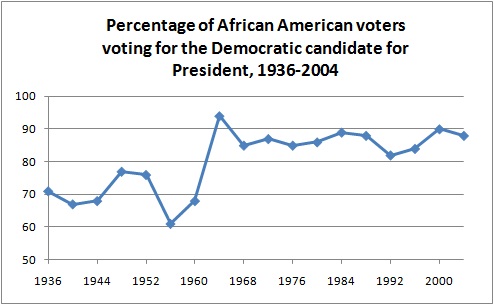
Source: Blacks & the 2008 Democratic National Convention, by David A. Bositis, Joint Center For Political And Economic Studies; table 1 on page 15; 1936-56 data from
Everett Carll Ladd, Jr., and Charles D. Hadley, Transformations of the American Party System; 1960-80 presidential preference data from Gallup Opinion Index; details available at www.JointCenter.org
Source: OnTheIssues FactCheck on Condi vs. Hillary, by Dick Morris
, Apr 15, 2011
Rallied nation to pass civil rights bill as JFK legacy
In 1952 and 1956, a majority of blacks backed the Republican Party. The Democratic domination of the African American vote really did not begin until 1960, when Kennedy dramatically called Coretta Scott King, the wife of Dr. Martin Luther King, after
her husband was sent to prison in Georgia. On Election Day, blacks showed their appreciation by voting for Kennedy by a margin of 70-30, more than enough to give the Democrat the victory over Richard Nixon. In 1964, the black preference for the
Democrats became a landslide, as president Lyndon Johnson rallied a grieving nation after Kennedy's assassination to demand passage of the strong civil rights bill JFK had proposed during his last year in office. Backed by a national outcry,
Johnson jammed through the far-reaching legislation, which ended discrimination against blacks in virtually every area of national life. Ironically, it was only with strong Republican support that the bill was able to pass.
Source: Condi vs. Hillary, by Dick Morris, p. 56-57
, Oct 11, 2005
1965: Freedom is not enough; we seek equality of results
The Civil Rights Act of 1964 prohibited discrimination. Unfortunately, Johnson was not content with legislation that, to him, merely made discriminatory practices illegal and sought to treat all citizens equally regardless of race or ethnicity. In his
1965 commencement address at Howard University, in the section of his remarks titled "Freedom Is Not Enough," Johnson stated:"It is not enough just to open the gates of opportunity. All our citizens must have the ability to walk through those gates.
This is the next and the more profound stage of the battle for civil rights. We seek not just freedom but opportunity. We seek not just legal equity but human ability, not just equality as a right and a theory but equality as a fact and equality as a
result. To this end equal opportunity is essential, but not enough."
With the affirmative action and quota laws that were subsequently passed, Blacks were no longer viewed as individuals.
Source: They Think You're Stupid, by Herman Cain, p. 36
, Jun 14, 2005
Take civil rights to the country as a moral crusade
Now that LBJ was in command he was committed to the shattering of the political and social structure, for it would take no less than that to reintroduce the poor, the aged, the blacks, those denied an education, to a new opportunity which, as
LBJ saw it, was absolutely essential to an equitable America.The president should take civil rights to the people, over the heads of Congress, and take it to the country as a moral crusade flattening all opposition with the sharp edge of principle
and moral rightness. He had prophesied the civil rights legislation would bog down, led into quicksand by the crafty parliamentary-wise southern Senate patriarchs, unless special and visibly muscular efforts were put forth. Now he was in the captain's
chair and he spoke almost eagerly about his commitment to get civil rights off its backside in the Congress and give it legs. He would not compromise, he said, for this was going to be a fight to the finish and he had no qualms about the outcome.
Source: A Very Human President, by Jack Valenti, p.152-153
, Dec 1, 1976
Jenkins Affair: My gay aide was set up by GOP
On Oct. 19, 1964, Walter Jenkins had been arrested as a homosexual under circumstances that were as grimy as possible. The news media were about to reveal that the Special Assistant to the President of the US had been seized in a pay toilet in the
YMCA two blocks from the White House.Two years later, Johnson still insisted vehemently in private that the Jenkins arrest resulted from a GOP frame-up and "someday we will prove it."
[In Oct. 1964] he released a statement of sympathy for
Jenkins who "has worked with me faithfully for 25 years, with dedication, devotion and tireless labor" but with no appreciation for Jenkins the public servant.
50 or perhaps even 30 years earlier, the charge of a homosexual on the White House
staff would have loosed a flood of sustained and severely damaging moral indignation. But by 1964, a considerable portion of the American population was educated enough to view homosexuality not as a sin but as a physical deviation or a form of sickness.
Source: Tragedy of Lyndon Johnson, by Eric F. Goldman, p.249-251
, Mar 1, 1974
We Democrats feel sorry for gays; it's an illness
Emerging from his presidential jet at San Diego's airport one night last week, Lyndon Johnson stopped to chat with newsmen. When one of the reporters referred to the Jenkins affair [in which LBJ's top White House aide,
Walter Jenkins, was arrested for a homosexual incident in the YMCA just prior to the 1964 election], the President suddenly exploded: "President Eisenhower had the same type of problem with his appointments secretary. The only difference is, we
Democrats felt sorry for him and thought it was a case of sickness and disease, and we didn't try to capitalize on a man's misfortune. We never mentioned it."
Lyndon's comment sent reporters scrambling for phones, caused many an eyebrow to arch in puzzlement--including Dwight Eisenhower's.
Source: Time magazine, "Johnson & the Jenkins Case"
, Nov 6, 1964
Spearheaded passage of the Civil Rights Acts of 1957 & 1960
In the field of civil rights, there were those who doubted that a native of the state of Texas would do anything effective in this area. Johnson said in a speech on the Senate floor: "For those who would seek to keep any group in our nation in bondage
I have no sympathy or tolerance. I believe sincerely, that we have a system of representative government that is strong enough, flexible enough, to permit all groups to work together toward a better life."
As Majority Leader, he lived up to the sentiments he had expressed when he was a freshman Senator. He spearheaded the passage of the Civil Rights Act of 1957. It was the first civil rights legislation to be enacted in 82 years.
He was equally successful in getting congressional approval for the Civil Rights Act of 1960, which established a new registration procedure designed to insure Negroes the right to vote.
Source: The Lyndon Johnson Story, by Booth Mooney, p. 147-148
, Jun 1, 1964
Malcolm X: LBJ had no "genuine interest" in blacks pre-1964
Malcolm X's "The Ballot or the Bullet" speech, Cory Methodist Church, Cleveland, USA, Friday 3 April 1964. "A ballot is like a bullet.
You don't throw your ballots until you see a target and, if that target is not within your reach, keep your ballot in your pocket."Malcolm X noted that
1964 was an election year, a time: "When all of the white political crooks will be right back in your and my community with their false promises which they don't intend to keep." He said that President Johnson and the Democratic Party supposedly
supported the civil rights bill but there was very little evidence of genuine interest. He maintained that, even though the Democrats controlled both the House of Representatives and the Senate, politicians hadn't taken genuine action to pass the bill.
Source: The 100 Greatest Speeches, by Kourdi & Maier, p.179-180
, Apr 3, 1964
- Click here for definitions & background information on Civil Rights.
- Click here for VoteMatch responses by Lyndon Johnson.
- Click here for AmericansElect.org quiz by Lyndon Johnson.
|
|
Other past presidents on Civil Rights: |
Lyndon Johnson on other issues: |
Former Presidents:
Barack Obama(D,2009-2017)
George W. Bush(R,2001-2009)
Bill Clinton(D,1993-2001)
George Bush Sr.(R,1989-1993)
Ronald Reagan(R,1981-1989)
Jimmy Carter(D,1977-1981)
Gerald Ford(R,1974-1977)
Richard Nixon(R,1969-1974)
Lyndon Johnson(D,1963-1969)
John F. Kennedy(D,1961-1963)
Dwight Eisenhower(R,1953-1961)
Harry S Truman(D,1945-1953)
Past Vice Presidents:
V.P.Joseph Biden
V.P.Dick Cheney
V.P.Al Gore
V.P.Dan Quayle
Sen.Bob Dole
Political Parties:
Republican Party
Democratic Party
Libertarian Party
Green Party
Reform Party
Natural Law Party
Tea Party
Constitution Party
|
Abortion
Budget/Economy
Civil Rights
Corporations
Crime
Drugs
Education
Energy/Oil
Environment
Families/Children
Foreign Policy
Free Trade
Govt. Reform
Gun Control
Health Care
Homeland Security
Immigration
Infrastructure/Technology
Jobs
Principles/Values
Social Security
Tax Reform
War/Iraq/Mideast
Welfare/Poverty
|
|
|
Page last updated: Feb 22, 2022