|
|
Books by and about 2020 presidential candidates |
|
Crippled America,
by Donald J. Trump (2015) |
United,
by Cory Booker (2016) |
The Truths We Hold,
by Kamala Harris (2019) |
Smart on Crime,
by Kamala Harris (2010) |
Guide to Political Revolution,
by Bernie Sanders (2017) |
Where We Go From Here,
by Bernie Sanders (2018) |
Promise Me, Dad ,
by Joe Biden (2017) |
Conscience of a Conservative,
by Jeff Flake (2017) |
Two Paths,
by Gov. John Kasich (2017) |
Every Other Monday,
by Rep. John Kasich (2010) |
Courage is Contagious,
by John Kasich (1998) |
Shortest Way Home,
by Pete Buttigieg (2019) |
The Book of Joe ,
by Jeff Wilser (2019; biography of Joe Biden) |
Becoming,
by Michelle Obama (2018) |
Our Revolution,
by Bernie Sanders (2016) |
This Fight Is Our Fight,
by Elizabeth Warren (2017) |
Higher Loyalty,
by James Comey (2018) |
The Making of Donald Trump,
by David Cay Johnston (2017) |
|
Books by and about the 2016 presidential election |
|
What Happened ,
by Hillary Clinton (2017) |
Higher Loyalty ,
by James Comey (2018) |
Trump vs. Hillary On The Issues ,
by Jesse Gordon (2016) |
Hard Choices,
by Hillary Clinton (2014) |
Becoming ,
by Michelle Obama (2018) |
Outsider in the White House,
by Bernie Sanders (2015) |
|
|
Book Reviews |
(from Amazon.com) |
(click a book cover for a review or other books by or about the presidency from Amazon.com)
|
Herding Cats
A Life in Politics,
by Sen. Trent Lott
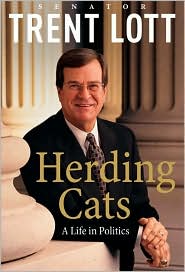
(Click for Amazon book review)
Click on a participant to pop-up their full list of quotations
from Herding Cats, by Trent Lott (number of quotes indicated):
- Bill Clinton (1)
- Phil Gramm (1)
- Ronald Reagan (2)
- Trent Lott (7)
OR click on an issue category below for a subset. |
BOOK REVIEW by OnTheIssues.org:
Poor Trent Lott. His whole life, he kept his nose clean; built a solid reputation; and methodically worked his way up to the leadership of the U.S. Senate. This book should have highlighted his career at its culmination. But instead, his memoir had to be spent justifying a silly remark at a birthday party. You really have to feel sorry for a guy who did the right thing for forty years of public service, but will be remembered for forty words.
Alas, Sen. Lott recognizes that reality. The first chapter of the book focuses entirely on "the forty words," as does the memoir's final two chapters and epilogue. Did he say something so terrible that he should have been forced to resign as Senate Majority Leader, and eventually resign from the Senate? You can decide; here are the forty words, from chapter 17, which is entitled "Forty Words":
| |
Dec. 5, 2002; p. 246:
"I want to say this about my state. When Strom Thurmond ran for president, Mississippians voted for him. And if the rest of the country had followed our lead, we wouldn't have had all these problems over the years either."
| |
Sounds pretty innocuous -- a paean to his state's senior senator on his 100th birthday. But Strom Thurmond ran as a Dixiecrat, on an explicitly racist and pro-segregation platform. (That was in 1948. You might remember that race for the famous photo of Harry Truman holding up a newspaper headline saying, "Dewey Defeats Truman!" Truman actually won the election because Thurmond won the electoral votes of four southern states). The press -- and especially the Internet -- went crazy exploring whether Lott's remarks justified or tolerated racism; whether Thurmond and Mississippi had actually moved on from segregation; and whether Lott could still lead the Senate afterwards. After weeks of merciless press scrutiny, Lott announced he would not run for re-election as Senate Majority Leader.
Lott stayed in the Senate. Evidently the voters of Mississippi forgave Lott, because he easily won re-election in 2006, right after he wrote this book.
We pundits might forgive him for his birthday remarks, but we will never forgive his ignominious end of his Senate tenure: Lott resigned in December 2007 so that he could become a lobbyist under rules which changed in January 2008. His early resignation forced a special election. Lott opened his lobbying business three weeks after resigning. His memoir does not mention that he might be planning to resign. I consider Lott's final resignation -- thumbing his nose at democracy and at his constituents of Mississippi in order to personally cash in on his connections -- to be Lott's truly unforgivable mistake.
Lott's memoir about his career SHOULD have been about more than how it ended. Lott reveals in this book how he served as the key for Bill Clinton's "triangulation" policy. Triangulation, as invented by political strategist Dick Morris, meant that Clinton worked with Senate Republicans to negotiate in advance what Clinton considered reasonable compromises on welfare reform and other issues. The Senate Republicans, led by Trent Lott, would then push through the legislation, which Clinton would immediately sign, and both sides would take credit for bipartisan success. Most pundits credit the legislative successes of triangulation as the key to Bill Clinton's 1996 re-election. Lott recognized that likely outcome, but considered the important legislative successes to be sufficient justification.
Lott's long career has numerous interesting anecdotes about his political colleagues, which we explore in our excerpts below. And of course we explore Lott's justification for his Forty Words, and his numerous explanations of how he's not a racist and never has been.
-- Jesse Gordon, jesse@OnTheIssues.org, December 2008
| OnTheIssues.org excerpts: (click on issues for details)
|
Budget & Economy
Trent Lott: 1981: Pushed for $80B cut in federal spending.
|
Civil Rights
Trent Lott: 1962: Turned away racist groups at Ole Miss.
|
Free Trade
Ronald Reagan: 1985: Vetoed import tariffs on textile goods.
Trent Lott: 1985: Led drive for import tariffs on textile goods.
|
Principles & Values
Bill Clinton: 1996: Legislative alliance with GOP Senate Leader Trent Lott.
Phil Gramm: Switched party after backlash from Gramm-Latta bill.
Trent Lott: Resides on Mississippi Coast overlooking Gulf of Mexico.
Trent Lott: Resigned as Senate Leader over 2002 toast to Strom Thurmond.
Trent Lott: 1996: Legislative alliance with Bill Clinton via Dick Morris.
|
Tax Reform
Ronald Reagan: 1985 Tax Code has unfair loopholes for real estate industry.
Trent Lott: 1985: Regrets supporting Reagan's tax reform.
|
The above quotations are from Herding Cats
A Life in Politics,
by Sen. Trent Lott.
|